

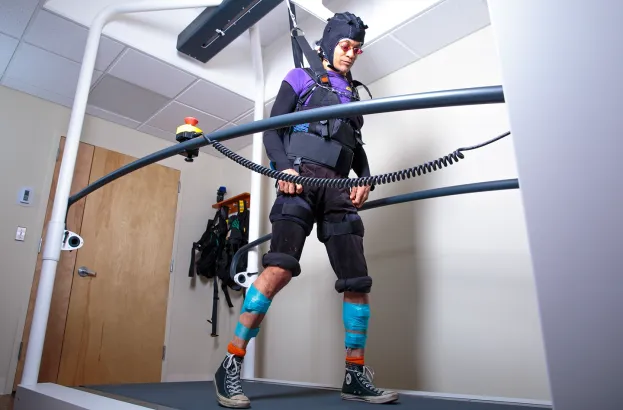
Personalized Virtual Reality-Based Training to Improve Gait and Balance and Reduce Falls in Older Adults with Mild Cognitive Impairment
This study assesses the effectiveness of combining thinking tasks with walking training to improve walking and balancing ability and reducing falls in older adults with mild cognitive impairment.
Your Support Drives Change
When you give to Kessler Foundation, you make a difference in the lives of aging adults.

Mark Jay, Aging Well
Aging is inevitable. At 60, participating in Kessler Foundation’s modified Story Memory Technique study was a meaningful experience for Mark...
Our Scientists Studying Mild Cognitive Impairment and Healthy Aging


FAQs About Mild Cognitive Impairment and Health Aging Research
Mild cognitive impairment causes noticeable changes in memory and thinking that are greater than expected with normal aging. While these changes may be frustrating, they usually do not prevent people from carrying out their daily activities.
Cognitive rehabilitation uses evidence-based strategies to improve memory, learning, attention, and other thinking skills. Kessler Foundation researchers have pioneered cognitive rehabilitation techniques that help older adults maintain cognitive function and everyday independence. Learn more on our Cognition Research page.
Yes. Kessler Foundation modified Story Memory Technique (KF-mSMT®) is a cognitive rehabilitation program developed by our researchers to help improve learning, memory, and everyday functioning in older adults and people with mild cognitive impairment. See the FAQs below to learn how KF-mSMT works and what research has shown.
Our researchers study innovative rehabilitation technologies, including augmented reality and cognitive-integrated treadmill training, to improve walking, balance, and mobility while reducing fall risk in older adults with mild cognitive impairment. Learn more at our Center for Mobility and Rehabilitation Engineering Research.
Visit Kessler Foundation's Join a Study page to explore current studies on healthy aging and mild cognitive impairment. If you find a study that interests you, complete the online inquiry form to learn whether you qualify.
KF-mSMT is a cognitive rehabilitation program developed by Kessler Foundation researchers to help people improve learning and memory. The 10-session program teaches practical memory strategies that people can use in everyday life, such as remembering appointments, names, directions, and shopping lists.
KF-mSMT teaches people to connect new information with meaningful stories and mental images. These techniques help make information easier to learn, store, and recall during everyday activities.
Yes. Studies led by Kessler Foundation researchers have shown that KF-mSMT can improve learning, memory, and everyday memory performance. Participants and their family members also report meaningful improvements in daily life. Functional magnetic resonance imaging (fMRI) studies have shown changes in brain activity after treatment, suggesting that participants use brain networks involved in memory more efficiently.
Yes. The protocol has been translated into Spanish and is used by clinicians in the United States, Mexico, and Argentina. A Chinese translation has also been completed, and additional translations are in development.
Yes. A Kessler Foundation Real-Life Science article explains how KF-mSMT helps people use stories and mental imagery to remember everyday information. The research summary explains the science behind KF-mSMT, how the technique works in everyday situations, and why it has been effective for people with conditions that affect memory.
