
East Hanover, NJ – November 6, 2026 – Nearly four in 10 working-age Americans with disabilities had a job in October, holding employment near the all-time high set in September, with the employment-to-population ratio at 39.9 percent. That steady performance came during a month in which the nation added 165,000 jobs, and the official unemployment rate edged down to 4.1 percent.
That’s according to today’s National Trends in Disability Employment (nTIDE) Jobs Report, issued by Kessler Foundation and the University of New Hampshire’s Institute on Disability. nTIDE tracks employment and labor force trends for people with and without disabilities. “The growth in the labor market numbers for people with disabilities over the past several months has been phenomenal,” said Andrew Houtenville, PhD, professor of economics and director of the UNH-IOD.
Employment for people with disabilities held near record levels in October. Based on data from today’s BLS Jobs Report and nTIDE analysis, the employment-to-population ratio for people with disabilities (ages 16-64) decreased slightly from 40.3 percent in September 2026 to 39.9 percent in October 2026 (down 1.0 percent or 0.4 percentage points). For people without disabilities (ages 16-64), the employment-to-population ratio increased slightly from 75.0 percent in September 2026 to 75.3 percent in October 2026 (up 0.4 percent or 0.3 percentage points). The employment-to-population ratio, a key indicator, is the percentage of people who are working relative to the total population (the number of people working divided by the total population, then multiplied by 100).
“The employment-to-population ratio for people with disabilities held near record highs at 39.9 percent in October,” said John O’Neill, PhD, director of the Center for Employment and Disability Research at Kessler Foundation. “This sustained level may reflect more people with disabilities entering the labor market as families cope with inflation. That is particularly notable given the very high poverty rates among families that include a member with a disability,” he added.
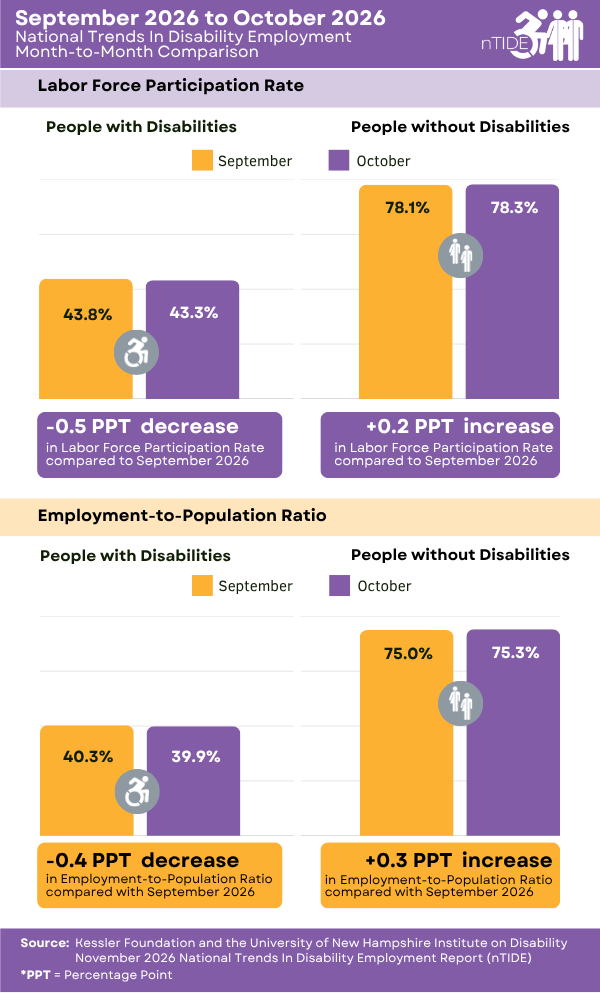
Employment of people with disabilities holding steady: remaining near all-time high set in September. From September 2026 to October 2026, the employment-to-population ratio decreased from 40.3 to 39.9 percent for people with disabilities and increased from 75 to 75.3 percent for people without disabilities. The labor force participation rate decreased from 43.8 to 43.3 percent for people with disabilities and increased from 78.1 to 78.3 percent for people without disabilities.
Year-to-Year Comparisons Are Not Available for October 2026
Because the federal government shutdown halted Current Population Survey (CPS) data collection in October 2025, year-over-year comparisons are not available this month. In October 2026, among workers ages 16-64, the 6,639,000 workers with disabilities represented 4.4 percent of the total 152,321,000 workers in the U.S.
Ask Questions about Disability and Employment
On the same day nTIDE is issued, the team hosts an nTIDE Lunch and Learn webinar. This live Zoom broadcast gives attendees a chance to ask questions about the latest findings, hear news and updates from the field, and learn from invited panelists who discuss current disability-related research and events.
On November 6, 2026, guest presenter David Xiao, a corporate disability leader and author of the LEADS Framework for Disability Inclusion, an open-access, employee-centered assessment tool for corporate disability inclusion, joins Drs. O’Neill and Houtenville, and Kimberly Knackstedt, executive director at the Association of University Centers on Disabilities. Visit the nTIDE archives at ResearchonDisability.org/nTIDE to see a recording of this nTIDE Lunch and Learn episode.
