
East Hanover, NJ – July 2, 2026 – Employment for people with disabilities held steady in June as job seeking rose notably, pointing to continued resilience in the U.S. labor market amid shifts in the global economy. The finding comes from the July 2026 National Trends in Disability Employment (nTIDE) report issued today.
Issued monthly by Kessler Foundation and the University of New Hampshire’s Institute on Disability, nTIDE tracks how broader economic conditions affect employment trends for people with and without disabilities.
Based on data from today’s BLS Jobs Report and separate nTIDE analysis, the employment-to-population ratio for people with disabilities (ages 16-64) increased slightly from 37.8 percent in May 2026 to 38.0 percent in June 2026 (up 0.5 percent or 0.2 percentage points). For people without disabilities (ages 16-64), the employment-to-population ratio decreased slightly from 75.0 percent in May 2026 to 74.8 percent in June 2026 (down 0.3 percent, or 0.2 percentage points). The employment-to-population ratio, a key indicator, is the percentage of people who are working relative to the total population (the number of people working divided by the total population, then multiplied by 100).
“This month’s small increase in labor force participation indicates that employment among people with disabilities is holding steady and remains well within the historically high post-COVID employment range,” said John O’Neill, PhD, director of the Center for Employment and Disability Research at Kessler Foundation.
Month-to-Month nTIDE Numbers (comparing May 2026 to June 2026)
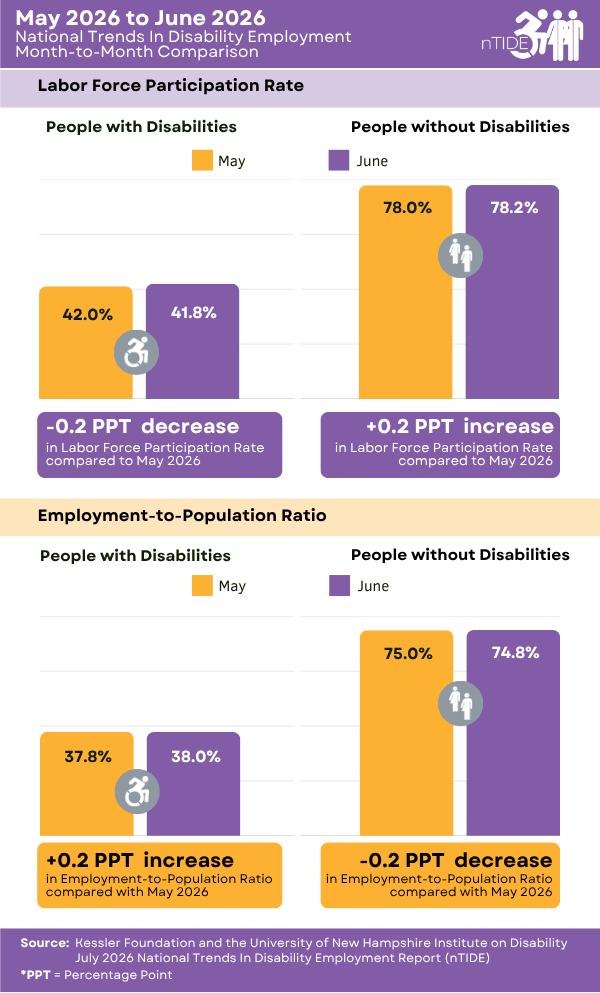
In contrast, the labor force participation rate for people with disabilities (ages 16-64) decreased slightly from 42.0 percent in May 2026 to 41.8 percent in June 2026 (down 0.5 percent, or 0.2 percentage points). For people without disabilities (ages 16-64), the labor force participation rate increased slightly from 78.0 percent in May 2026 to 78.2 percent in June 2026 (up 0.3 percent or 0.2 percentage points). The labor force participation rate reflects the percentage of people who are in the labor force (working, on temporary layoff, on furlough, or actively looking for work in the last four weeks) relative to the total population (the number of people in the labor force divided by the number of people in the total population multiplied by 100).
“Month-to-month fluctuations are expected, but the broader story remains one of stability. The labor force participation rate for people with disabilities continues to hold near 41 percent, maintaining the higher plateau that emerged after the COVID-19 pandemic," said Andrew Houtenville, PhD, professor of economics and director of the UNH-IOD.
Year-to-Year nTIDE Numbers (comparing June 2025 to June 2026)
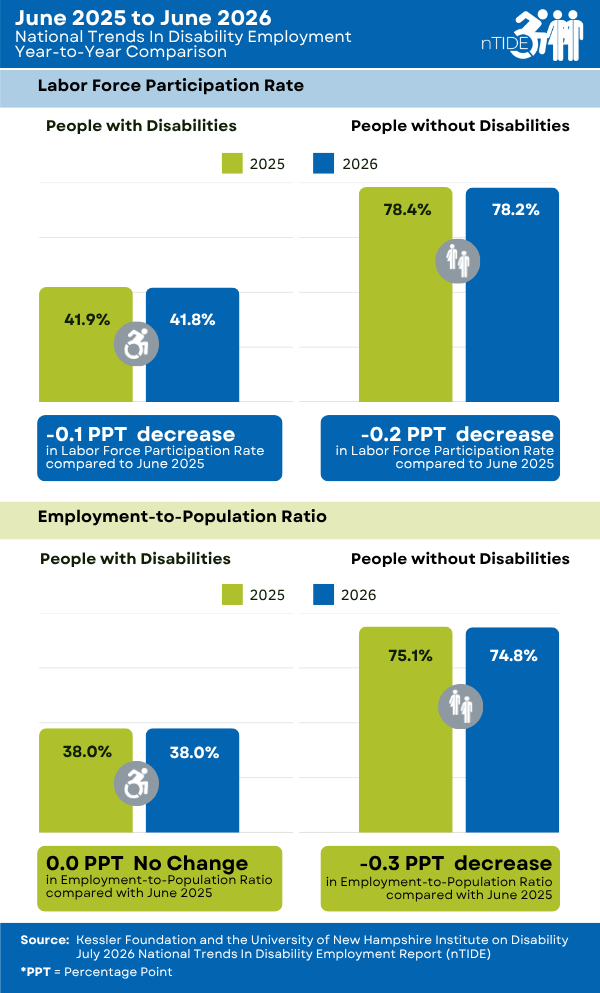
Compared with the same time last year, the employment-to-population ratio for people with disabilities (ages 16-64) remained the same at 38.0 in June 2025 and June 2026. For people without disabilities (ages 16-64), the employment-to-population ratio decreased slightly from 75.1 percent in June 2025 to 74.8 percent in June 2026 (down 0.4 percent, or 0.3 percentage points).
The labor force participation rate for people with disabilities (ages 16-64) decreased slightly from 41.9 percent in June 2025 to 41.8 percent in June 2026 (down 0.2 percent or 0.1 percentage point). For people without disabilities (ages 16-64), the labor force participation rate decreased slightly from 78.4 percent in June 2025 to 78.2 percent in June 2026 (down 0.3 percent, or 0.2 percentage points).
In June, among workers ages 16-64, the 6,593,000 workers with disabilities represented 4.4 percent of the total 150,918,000 workers in the U.S.
Ask Questions about Disability and Employment
On the same day nTIDE is issued, the team hosts an nTIDE Lunch and Learn webinar. This live Zoom broadcast gives attendees a chance to ask questions about the latest findings, hear news and updates from the field, and learn from invited panelists who discuss current disability-related research and events.
On July 2, 2026, guest presenter Xueting Sun, postdoctoral fellow at the University of New Hampshire, joins Drs. O’Neill and Houtenville, and Lillie Heigl, director of policy at the Association of University Centers on Disabilities. Visit the nTIDE archives at ResearchonDisability.org/nTIDE to see a recording of this nTIDE Lunch and Learn episode.
