
East Hanover, NJ – October 2, 2026 – Although U.S. job growth slowed in September, employment among Americans with disabilities continued to rise, with the employment-to-population ratio reaching an all-time high of 40.3 percent. The milestone increase came during a month in which the nation added 29,000 jobs and the official unemployment rate edged up to 4.2 percent. That’s according to today’s National Trends in Disability Employment (nTIDE) Jobs Report, issued by Kessler Foundation and the University of New Hampshire’s Institute on Disability. nTIDE tracks employment and labor force trends for people with and without disabilities.
Based on data from today’s BLS Jobs Report and nTIDE analysis, the employment-to-population ratio for people with disabilities (ages 16-64) increased from 39.8 percent in August 2026 to 40.3 percent in September 2026 (up 1.3 percent or 0.5 percentage points). For people without disabilities (ages 16-64), the employment-to-population ratio increased from 74.6 percent in August 2026 to 75 percent in September 2026 (up 0.5 percent or 0.4 percentage points). The employment-to-population ratio, a key indicator, is the percentage of people who are working relative to the total population (the number of people working divided by the total population, then multiplied by 100).
"The employment-to-population ratio for people with disabilities was at an all-time high of 40.3 percent in September, breaking through the post-COVID employment plateau," said John O’Neill, PhD, director of the Center for Employment and Disability Research at Kessler Foundation. "Last month's numbers may have broken through the 40 percent barrier due to rising prices, necessitating people with disabilities to work to help support their families."
Month-to-Month nTIDE Numbers (comparing August 2026 to September 2026)
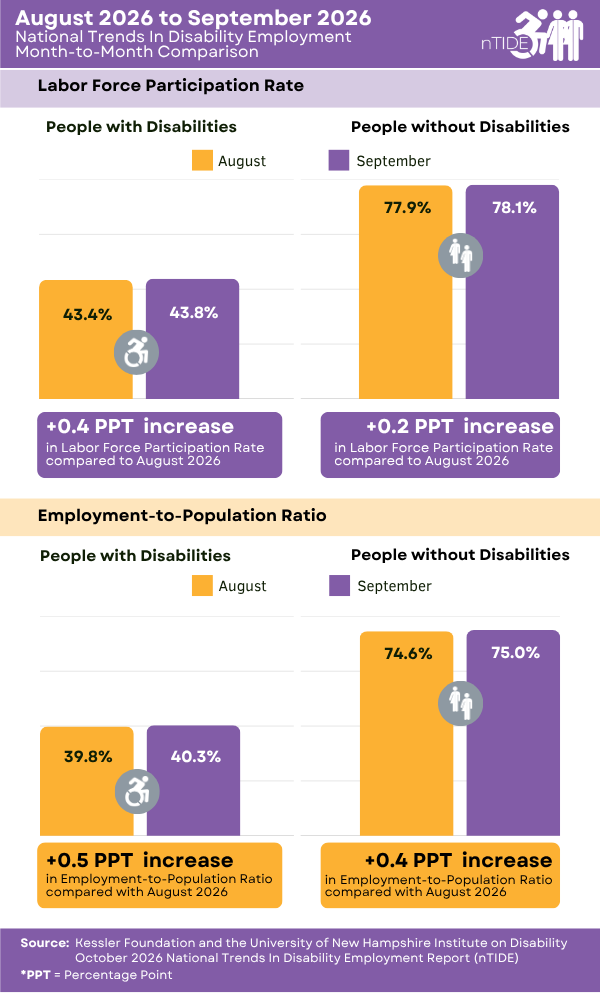
The labor force participation rate for people with disabilities (ages 16-64) slightly increased from 43.4 percent in August 2026 to 43.8 percent in September 2026 (up 0.9 percent or 0.4 percentage points). Similarly, for people without disabilities (ages 16-64), the labor force participation rate slightly increased from 77.9 percent in August 2026 to 78.1 percent in September 2026 (up 0.3 percent or 0.2 percentage points). The labor force participation rate reflects the percentage of people who are in the labor force (working, actively looking for work in the last four weeks, or on temporary layoff/furlough) relative to the total population (the number of people in the labor force divided by the number of people in the total population multiplied by 100).
“The labor market figures for people with disabilities over the past two months have been remarkable,” said Andrew Houtenville, PhD, professor of economics and director of the UNH-IOD. “The labor force participation of people with disabilities also reached a record level, 43.8 percent in September,” he added.
Year-to-Year nTIDE Numbers (comparing September 2025 to September 2026)
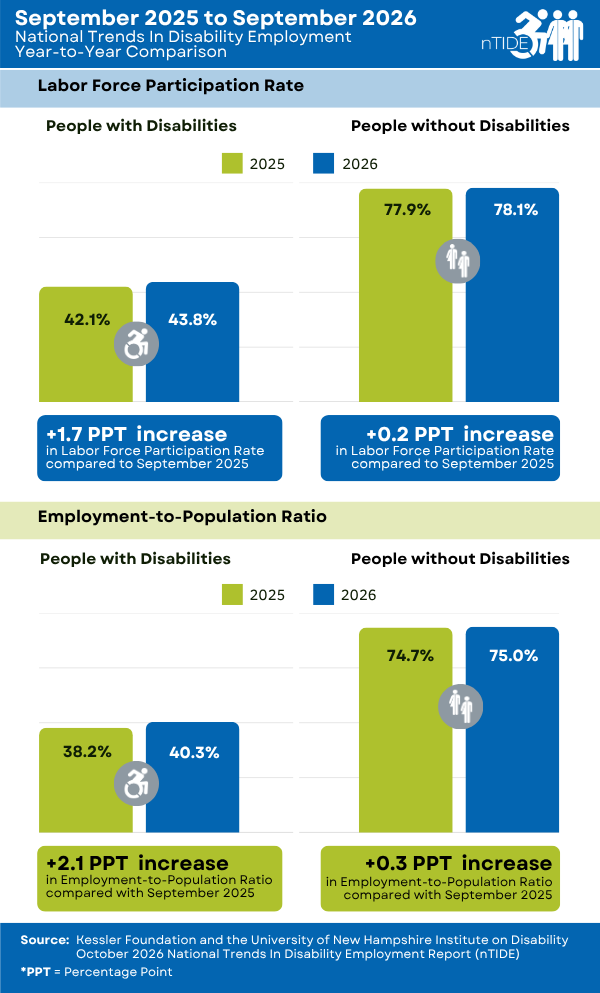
Compared with September 2025, employment and labor force participation continued to increase for people with disabilities. The employment-to-population ratio rose from 38.2 to 40.3 percent (up 2.1 percentage points), while the labor force participation rate increased from 42.1 to 43.8 percent (up 1.7 percentage points). For people without disabilities, the employment-to-population ratio increased from 74.7 to 75.0 percent (up 0.3 percentage points) and the labor force participation rate increased from 77.9 to 78.1 percent (up 0.2 percentage points).
In September, among workers ages 16-64, the 6,918,000 workers with disabilities represented 4.6 percent of the total 151785000 workers in the U.S.
Ask Questions about Disability and Employment
On the same day nTIDE is issued, the team hosts an nTIDE Lunch and Learn webinar. This live Zoom broadcast gives attendees a chance to ask questions about the latest findings, hear news and updates from the field, and learn from invited panelists who discuss current disability-related research and events.
On October 2, 2026, guest presenter Charyl S. Yarbrough, PhD, of the New Jersey Department of Labor & Workforce Development, joins Drs. O’Neill and Houtenville, and Kimberly Knackstedt, executive director at the Association of University Centers on Disabilities. Visit the nTIDE archives at ResearchonDisability.org/nTIDE to see a recording of this nTIDE Lunch and Learn episode.
