
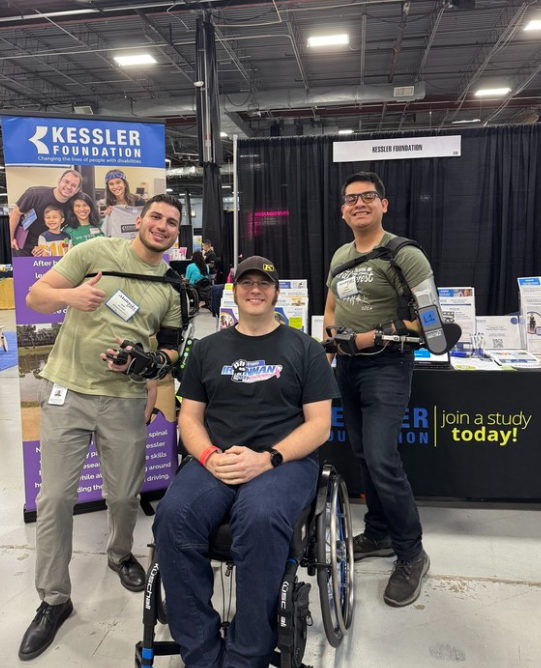
In April 2024, Walt Schumacher, a process engineer and national off-road motorcycle racer, sustained a spinal cord injury during a trip to Moab with his dad and friends. In November, he became the first person in New Jersey to undergo epidural implant surgery as part of a National Institutes of Health-funded initiative led by Claudia Angeli, PhD. Since his surgery, Walt has been working daily with Dr. Angeli and the Reynolds Center team.
“It’s a lot of hard work, but the Kessler Foundation team is incredible and putting in tremendous effort alongside me as I strive to regain function. Even if my
progress is modest, I’m part of a solution that will ultimately help everyone with spinal cord injury,” shares Walt. “Walt is helping us expand our understanding of spinal cord epidural stimulation and its benefits as we work to increase access to this life-changing technology,” notes Dr. Angeli.
Epidural spinal stimulation is one of the most promising breakthroughs in spinal cord injury rehabilitation in decades. Thanks to support from the Joseph and
Cheryl Marino Family Foundation, The Reynolds Foundation, and donors like you, Kessler Foundation’s Tim and Caroline Reynolds Center for Spinal Stimulation is the first in New Jersey to explore this technique, which aims to reactivate damaged neural pathways. “The goal,” says Gail Forrest, PhD, director of the Reynolds Center, “is to help people with spinal cord injury live more independently and thrive.”
Living with a spinal cord injury means so much more than not being able to walk. Common complications include impaired respiratory, cardiovascular, urinary, bowel, and hand function, along with issues such as spasticity, pain, pressure injuries, osteoporosis, and bone fractures. Epidural stimulation involves surgically
implanting a stimulator directly over the spinal cord. By combining this targeted stimulation with focused training, spinal circuits below the injury can begin to
function more like they did before the injury, helping the nervous system interpret important sensory signals related to specific activities and enabling movements previously impossible. Scientists at the Reynolds Center are investigating how this technique helps people regain lost function and voluntary movement. “We are leading global efforts to revolutionize the outlook for people with spinal cord injury,” says Steven Kirshblum, MD, co-director of the Reynolds Center and chief medical officer at Kessler Foundation and Kessler Institute for Rehabilitation. “With the continued generosity of our donors, we are bridging the gap between brain and body caused by spinal cord injury, and challenging the longstanding perception that it is incurable,” concludes Dr. Forrest.
