
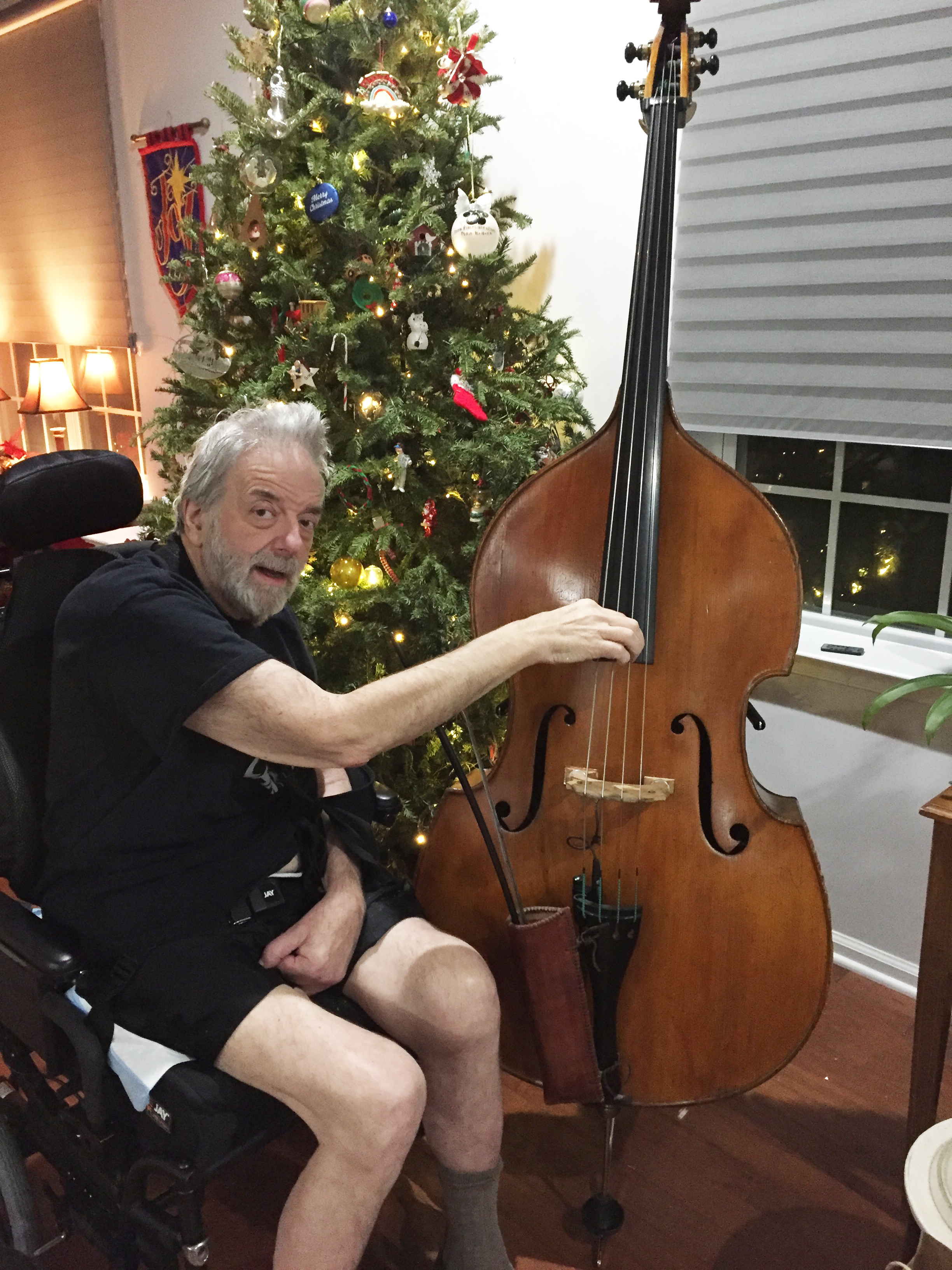
Steve Ascolese had a stroke in June 2020. Although he wasn't paralyzed, he lost use of his left arm, hand, and leg. “I had my stroke near the beginning of the pandemic. As part of my recovery, and to get fresh air, I’d make frequent trips in my power wheelchair around the neighborhood,” says Steve. Steve also experienced spatial neglect. “The spatial neglect prevented me from seeing the curb while directing my wheelchair. I came close to driving off the sidewalk many times,” Steve recalls. It also made reading impossible for him. “As an amateur musician, I was devastated that I couldn’t read sheet music.” When Steve learned about a Kessler Foundation study testing a new virtual reality treatment for spatial neglect, he eagerly joined.
Imagine living each day completely unaware of one side of your body and personal space. You might shave or apply makeup only to half of your face, ignore anyone approaching on one side, or step into street traffic because the red-light signal is on your affected side. You are unaware that anything is wrong. These severe symptoms are part of spatial neglect, a common but often undetected complication of stroke. Compared to other stroke patients, those with spatial neglect tend to recover more slowly physically and mentally, have lower self-awareness of their disability, and find it harder to return to their communities. The impact on patients varies from reduced quality of life to serious injuries. With support from the Wallerstein Foundation and the Charles and Ann Serraino Foundation, Kessler Foundation scientists have been researching this area since 2007, developing and testing tools to effectively identify and treat spatial neglect. Thanks to a 2021 grant from The Healthcare Foundation of New Jersey and support from Terri and Michael Goldberg, Kessler Foundation researchers are creating and testing a portable, home-based therapy program for spatial neglect using cutting-edge virtual reality.
This new project builds on the ongoing work of Peii (Peggy) Chen, PhD, senior research scientist at Kessler Foundation. Since 2017, Dr. Chen and her team have been testing and improving a clinic-based treatment for spatial neglect, resulting in the development of the innovative, immersive virtual reality therapy called the Kessler Foundation Spatial Retraining Therapy (KF-SRT™) System. This treatment involves patients wearing head-mounted goggles and using hand-tracking technology to perform various challenging motor tasks in a computer-generated environment. One major limitation of the clinic-based system is its high cost and lack of portability. Many people with spatial neglect cannot travel for treatment, others cannot afford outpatient therapy immediately after inpatient rehab, and there’s a pressing need for treatment options after inpatient care. To address this, Dr. Chen and her team are adapting the clinic system for use at home. “Immersive virtual reality technology is a new paradigm for spatial neglect rehabilitation,” explains Dr. Chen.
For Steve, the treatment made a significant difference, and it was enjoyable. “I enjoyed the games and activities on the training modules; they were never boring,” Steve reports. “I like that the modules can be used at home; that will save transportation time and cost.” “Thanks to Kessler Foundation research, I’ve retrained my brain after my stroke. My travels around the neighborhood are safe, and I can read and play music again. I’m grateful to be living more independently.”
