
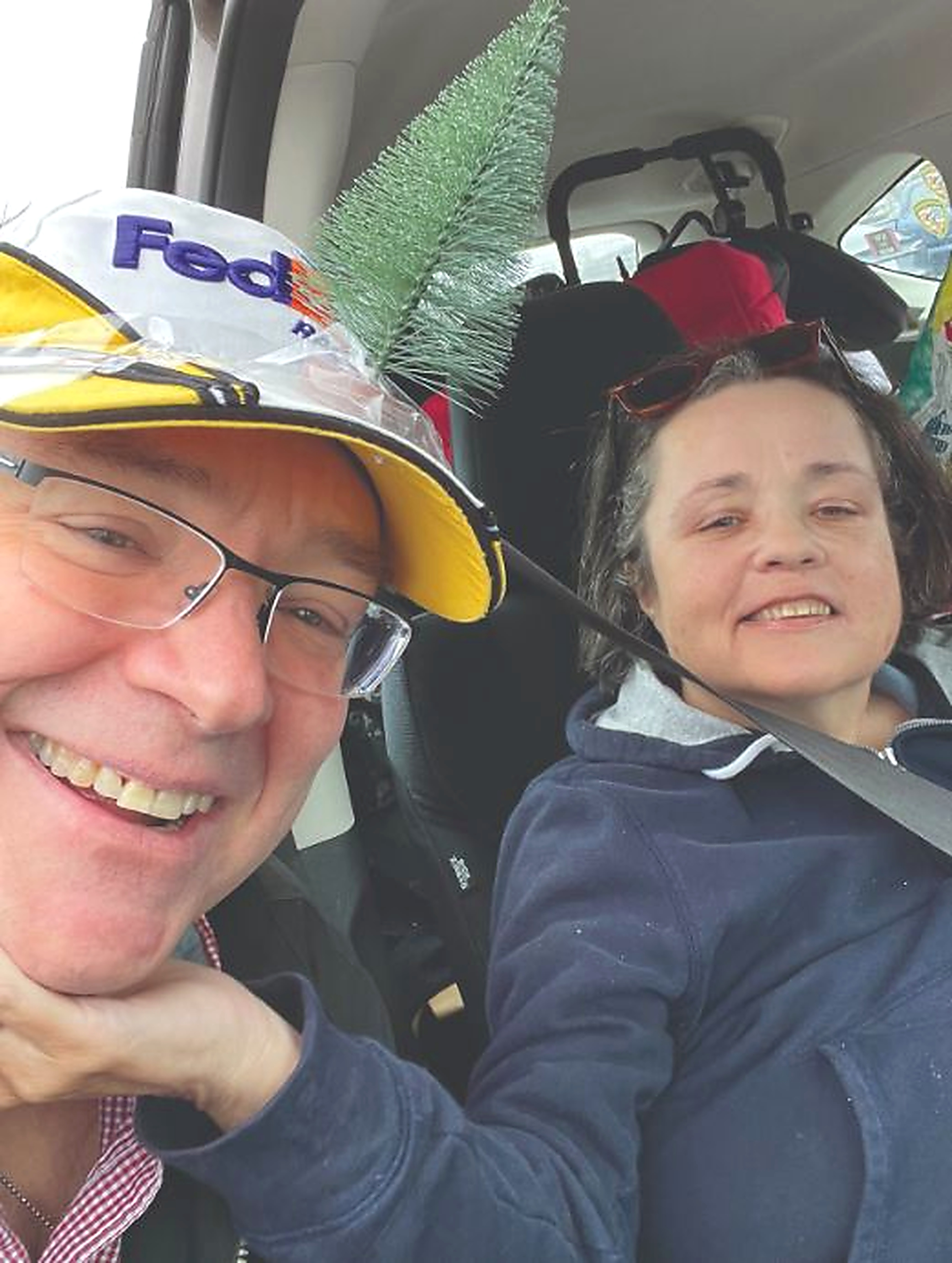
Seven years ago, teacher Maria Martin had a devastating stroke. With the support of her husband Peter, she’s come a long way, working hard to overcome challenges and volunteering to participate in Kessler Foundation research.
Therapy that is fun and engaging motivates patients to actively participate in rehabilitation and speeds their recovery. Using virtual reality and game-based activities, and with the generosity of many donors, including Terri and Michael Goldberg and the Wallerstein Foundation, scientists in the Center for Stroke Rehabilitation Research are expanding treatment options and developing ways to make them available beyond the rehabilitation clinic. Peii Chen, PhD, leads studies aimed at developing effective home-based treatment for the disabling symptoms of spatial neglect, a common but under-recognized complication of stroke and brain injury. Often unaware of this condition, individuals with spatial neglect experience a range of difficulties that hinder recovery, limit independence, and jeopardize safety. “Immersive virtual reality provides the intensive therapy needed to restore function,” explains Dr. Chen.
Wearing a virtual reality headset, participants engage in game-like activities under the guidance of a therapist. The activities are designed to improve performance over a 15-session, five-week course. The therapist travels to participants’ homes for each session, bringing a laptop computer, a virtual reality headset, and a Wi-Fi hotspot. “The equipment is portable,” Dr. Chen notes, “because the common goal of all our studies is to transition therapy to home.” Thanks to support from the Sea Grape Foundation, the development of a tele-rehab system is underway. The system will eliminate the need to travel to patients’ homes and allow access from any location. “Tele-rehab has the potential to transform the delivery of rehabilitative care,” Dr. Chen predicts.
The success of home-based therapy for people with spatial neglect, like Maria, depends on the support of family caregivers, like Peter. To actively engage them, the Center’s stroke team has developed a manual that provides step-by-step guidance for working with their family members on tasks to improve symptoms of spatial neglect. Research shows that caring for family members with spatial neglect is especially stressful. “Engaging caregivers in rehabilitation may not only improve patient outcomes but also quality of life for caregivers,” says Dr. Chen.
Maria admits she is hooked on virtual reality. Wearing a headset, she completes tasks much like a gamer competing for points in a video game. “The games are challenging but fun. I can see how people like me could benefit from this therapy.” Peter adds, “Everyone in our life is raving about how well Maria is doing. They almost take for granted what she can do now. I can’t thank Dr. Chen enough for helping us incorporate game-based practices into our routine. We’re combating the neglect. It’s incredible.”
Dr. Chen notes, “Although it has been years since her stroke, gains are still possible. That’s why we are working toward more home-based therapy programs that are both effective and accessible. This is how we can change the outlook for stroke survivors.”
