
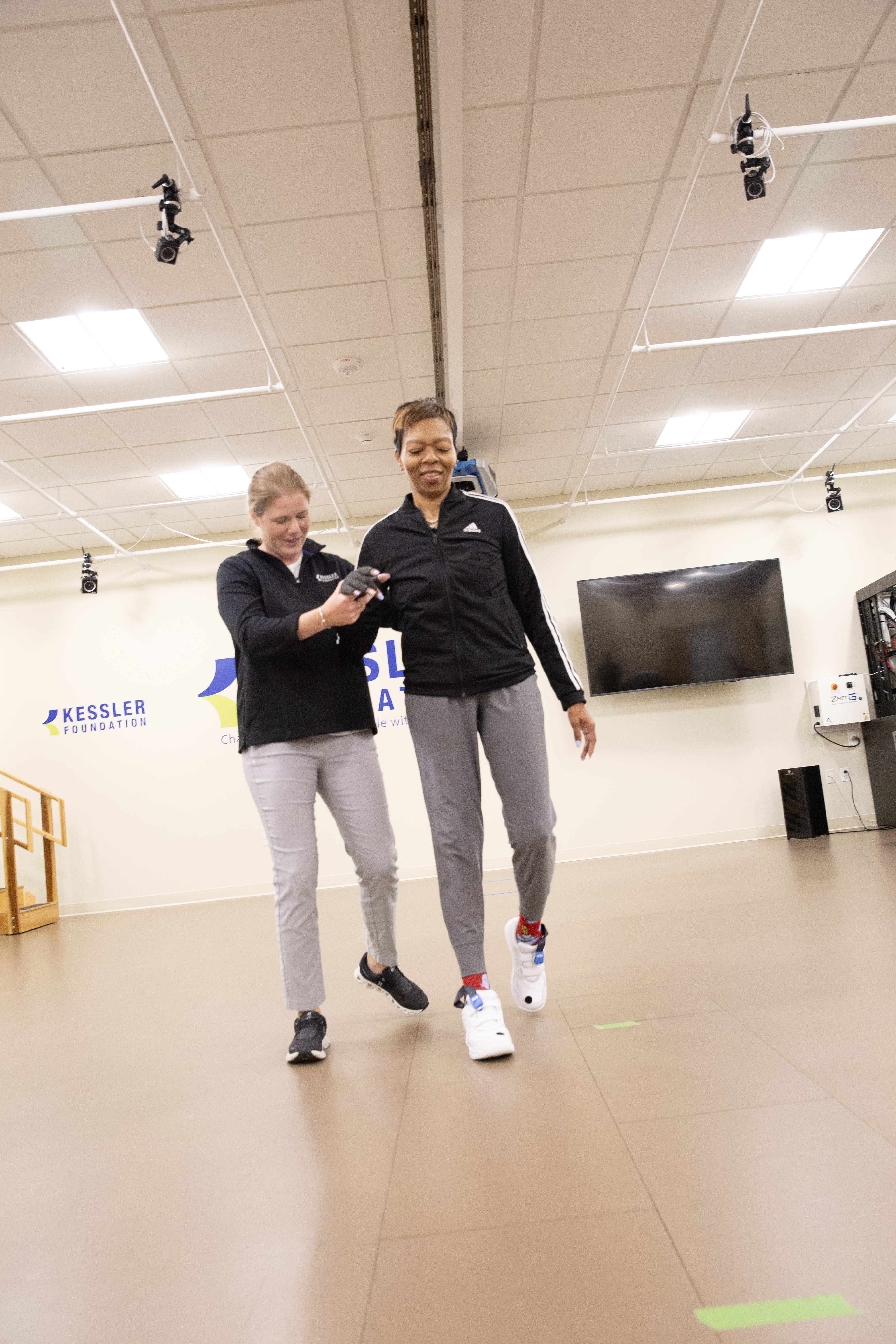
Racquel Porter, a charter school paraprofessional, survived a stroke last year. “It was life-changing,” Racquel says, “but it’s my nature to stay positive.” During her inpatient rehabilitation stay at Kessler Institute for Rehabilitation, she volunteered for a robotics study led by Karen J. Nolan, PhD. Paralyzed on one side, Racquel had to relearn to walk. “The exoskeleton was exciting. Every day, I accomplished something different. I could see improvement.”
Over the past decade, thanks to the support of many donors, Kessler Foundation has emerged as a leader in robotics research, achieving advances that have established new ways to restore mobility and independence after stroke and brain injury. Dr. Nolan credits this trailblazing reputation to the vision of Liz Lowenstein, who served as chair of the Kessler Foundation Board of Trustees from 2013 to 2016. “It all started with a gift in 2014 to purchase a second robotic exoskeleton,” Dr. Nolan recalls. “Over the years, Liz, her husband David, and her family’s Reitman Foundation have supported the expansion of our robotic exoskeleton research, and many other donors have followed suit.”
This has enhanced opportunities to collaborate with industry leaders and device manufacturers to investigate new exoskeleton technology. Using Kessler Foundation’s research data, several devices gained FDA clearance. “It is rewarding to work in a place that not only conducts life-changing research for patients but also provides feedback to the industry to improve technology for better outcomes,” remarks Dr. Nolan.
Early successes paved the way for additional funding and greater progress, culminating in a large federal grant for the first clinical trial of exoskeletons in adults with acute stroke, a large and growing population in need of new rehabilitation options. Inpatients at Kessler Institute for Rehabilitation are eligible for the study, which entails intensive, repetitive training in the exoskeleton. “We believe that intervening soon after stroke using the exoskeleton to retrain the individual’s gait will contribute to faster and more complete recovery,” says Dr. Nolan.
More than just another clinical trial, the study marks a fundamental shift in treatment protocols. Because of your generosity, robotic exoskeletons are on
the way to becoming a standard of care for the rehabilitation of mobility deficits after stroke and brain injury. Reflecting on this journey, Dr. Nolan says, “We started with the question, ‘How do wearable robots help walking?’ Then, ‘How do we maximize recovery?’ Now, we are asking, ‘How does intensive robotic therapy cause lasting changes in the brain?’ These questions will continue to evolve until we achieve the best possible outcomes for people affected by brain injury and stroke, people like Racquel Porter.”
At discharge, Racquel walked to her van for the ride home. “My children encouraged me to come to Kessler, and I’m grateful I did. The research at Kessler Foundation helped me start over.”
