
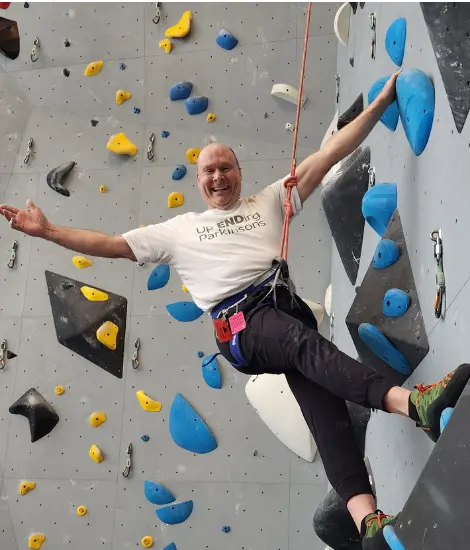
When John Rosiak was diagnosed with Parkinson’s disease in 2023, he didn’t despair; he took action. He searched for programs, studies, and clinical trials to
help him understand and manage the condition. He has participated in 15 studies, including one that led him to “Up ENDing Parkinson’s,” a novel rock-climbing program. “In the world of neurological rehabilitation, exercise is medicine,” says John. “And climbing pushes me both physically and cognitively. Remembering climbing routes is essential to success."
We’ve all heard the phrase that “timing is everything.” Now, a unique pilot study on learning and memory in people with Parkinson’s disease, made possible by the support of generous donors, is proving that timing is, indeed, a key factor. The study, led by Ekaterina Dobryakova, PhD, assistant director of neuroscience research at the Center for Traumatic Brain Injury Research, is examining how the timing of feedback affects a person with Parkinson’s disease's ability to process, retain, and recall new information. “Parkinson’s is a progressive neurological disorder affecting more than one million people nationwide,” says Dr. Dobryakova. “Parkinson's is typically associated with tremors and balance issues. However, the same chemical changes in the brain that lead to motor challenges may also result in cognitive impairment in more than 40 percent of this population,” she adds.
When John learned of the study, he joined right away. Using a computer-based program, study participants were tasked with learning 180 unrelated word pairs, such as “cat” and “mug.” They then went back and attempted to identify the correct pairs in the list. Feedback as to whether their responses were correct or not was provided at three different intervals: immediately for one 60-word set, with a six-minute delay for the second, and after 25 minutes for the third. “We found that retention and recall improve when feedback is delayed for about 25 minutes,” explains Dr. Dobryakova. “In other words, it appears that a long delay may help persons with Parkinson’s learn new information, which leads us to the next step in this investigation.”
With continued support, researchers aim to use functional magnetic resonance imaging to examine brain activity changes during learning in response to feedback delivered at different times. “Your commitment to Parkinson’s research will translate to more effective timing and delivery of therapeutic interventions, and, for that, we are all grateful,” adds Dr. Dobryakova.
John admits the study was a challenging but valuable experience. “I don’t see myself as just a study participant. I view myself as a partner in advancing scientific knowledge.” He's grateful for the support of others who share his commitment to enhancing quality of life for people with Parkinson’s.
