
By Deborah Hauss, Senior Staff Writer, Communications
A recent study from Kessler Foundation highlights a promising way to help stroke patients avoid falls during rehabilitation or hospital stays. The researchers focused on patients with spatial neglect, a common but often overlooked condition after stroke that makes it hard for people to notice things on one side—usually the same side as the weakened limb. Spatial neglect is not a problem with vision, but with how the brain processes space and attention.
The study found that patients with spatial neglect were 44% more likely to fall than those without it during inpatient rehabilitation, according to lead investigator Peii (Peggy) Chen, PhD, assistant director, Center for Stroke Rehabilitation Research. “Most of these falls happened in the patient’s own hospital room, not in therapy sessions or hallways. This makes the condition not only a challenge for recovery but also a clear safety risk.”
A simple therapy makes a big difference
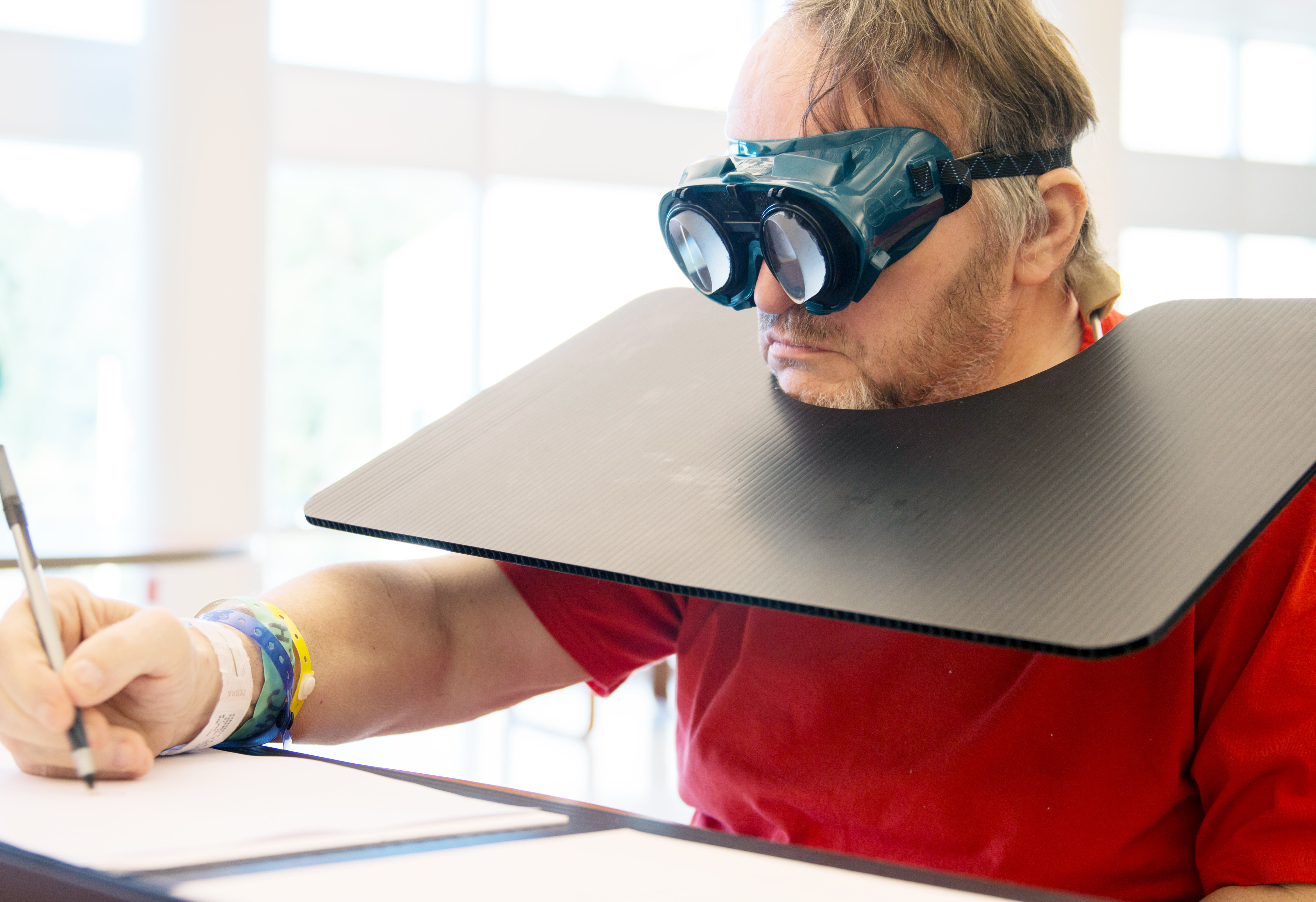
The most important finding? A simple therapy called Kessler Foundation Prism Adaptation Treatment (KF-PAT®) developed by Dr. Chen and other Foundation researchers helped reduce the number of falls. Prism adaptation treatment involves reaching for objects while wearing prism lenses that shift a person’s view slightly to one side. While wearing the lenses, their brain starts to adjust how it controls their arm movements.
After 10 to 15 minutes, the prism glasses are taken off, and their movements adjust back to normal. This process is called sensorimotor adaptation. In simple terms, sensorimotor adaptation is your brain’s way of adjusting your movements when something around you changes. It’s like learning to throw a ball with your non-dominant hand or getting used to walking on a moving escalator. Multiple sessions help rebuild connections in areas in the brain, and in turn, improve the ability of people with spatial neglect to pay attention to both sides of their body and their surroundings.
A key takeaway is how easy prism adaptation treatment is to deliver, making it a useful tool for therapists and care teams working with stroke patients. The sessions are short, do not require patients to learn a special skill, and can be included in regular occupational therapy.
The research found that:
- Patients who received more prism adaptation sessions had fewer falls after treatment
- More sessions also led to better improvement in everyday skills like dressing and walking
- Even patients with more severe spatial neglect showed gains when prism adaptation treatment was used consistently
- Prism adaptation treatment does not just improve attention and awareness but may also make patients safer and speed up their recovery
The study also shows how addressing spatial neglect directly—instead of just trying to prevent falls with alarms or bed rails—can make a real difference. By helping patients regain the ability to pay attention to both sides of their space, prism adaptation treatment improves safety, daily functioning, and quality of life.
Dr. Chen recommends that “Rehabilitation staff should screen stroke patients for spatial neglect soon after admission. Those who show signs of the condition may benefit from starting prism adaptation treatment early and completing enough sessions to make a real difference.” She also encourages future research into how to make patient rooms safer for individuals with spatial neglect—since that is where most falls occurred, especially from bed. “Simple changes, like signs reminding staff about a patient’s condition, or better design of bed rails, could help reduce risks even further,” suggests Dr. Chen.
Falls are a major concern during stroke rehabilitation. A single fall can cause injury, fear, or even delay recovery by days or weeks. Preventing falls means patients can stay on track with their therapy, regain independence faster, and feel more confident.
