
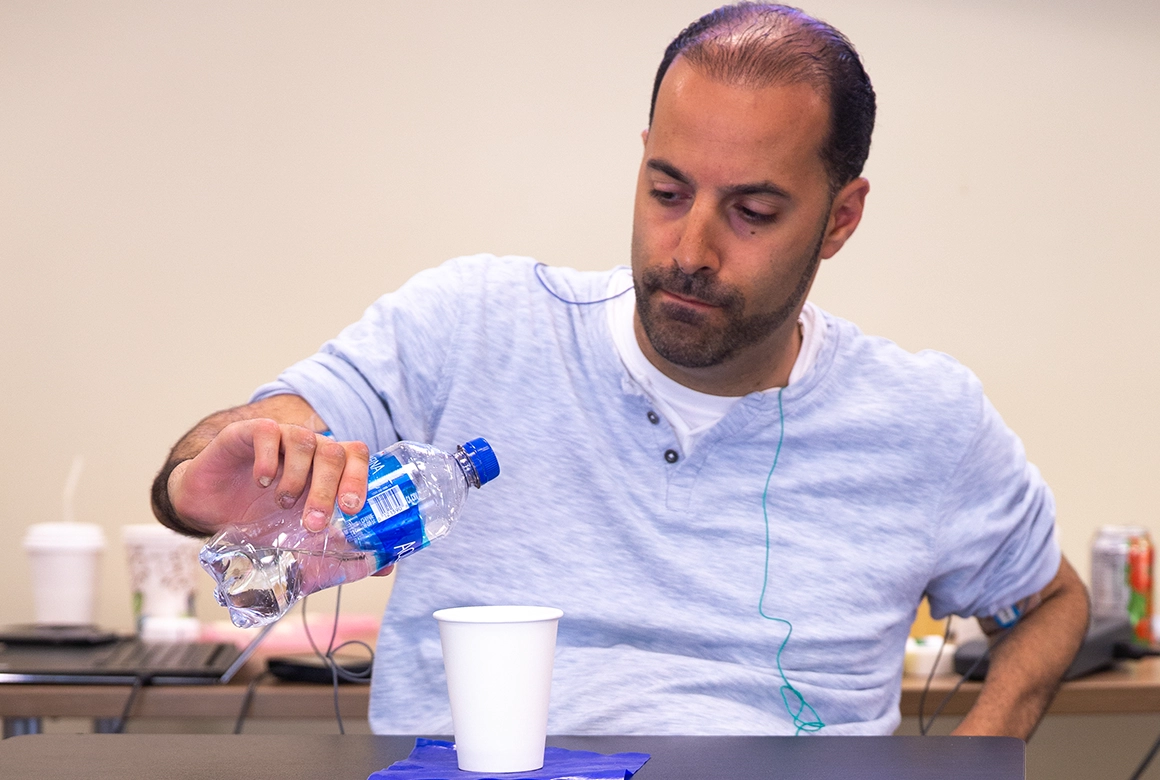
More than half of individuals with spinal cord injury have weakness and paralysis of their upper limbs. Small improvements in arm and hand function can have a large impact on a person’s ability to take care of themselves and their families and participate in work, school, and recreational activities.
At the Reynolds Center, participants in transcutaneous stimulation studies are making progress. Jimmy Brown describes what this study means to him and his family.
After sustaining a spinal cord injury in 2004, Jimmy approaches his post-injury rehabilitation with the same drive he exhibited on the baseball field as a pitcher for St. Peter’s University, a Division I school. Today, Jimmy continues his quest to regain strength and function.
“My ability to play competitive sports may have disappeared,” says Jimmy, “but my competitive drive remains. Over the years, I’ve joined many Kessler Foundation research studies, always pushing myself to get stronger,” says Jimmy.
“Because donors like you support advances in spinal stimulation research, I can pour a glass of water smoothly and accurately,” Jimmy explains. “That may seem small, but for me, improving fine motor skills in my hands and arms—with stimulation of my spinal cord—is life-changing. Now, everyday movements and actions are possible. I can help my wife, Francine, with chores and even play catch with my kids. As a former pitcher, throwing a baseball around means a lot.”
Jimmy says the drive he sees in Kessler Foundation researchers and the unending support from donors motivates him every day. “Donors like you not only feed my competitive drive to work harder and achieve more, you fill me with hope,” he concludes.
