
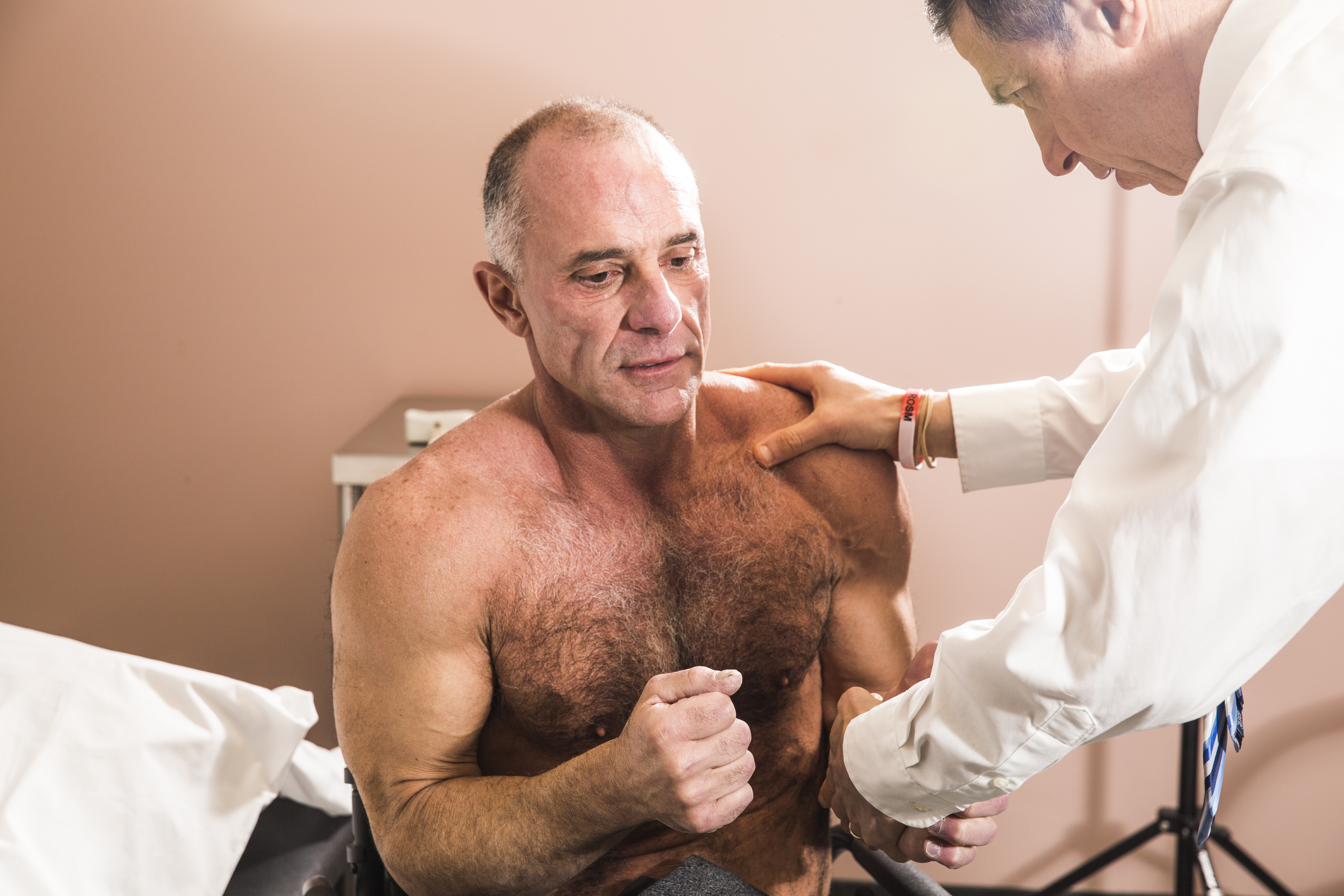
In 2017, Joe Monteforte, a wheelchair user with spinal cord injury and debilitating shoulder pain, faced the prospect of shoulder surgery, with its long recovery and risks for complications. Then Joe took part in the first pilot study conducted by the Derfner-Lieberman Laboratory for Regenerative Rehabilitation Research. His shoulder pain was relieved after he received a single injection of his own abdominal fat tissue into his shoulder joint (a procedure called autologous micro-fragmented adipose tissue [MFAT] injection).
Years later, Joe remains pain-free and leads an active lifestyle, including daily workouts and long outings with his wife, an avid race walker. “I use a state-of-the-art workout facility with the newest machines,” says Joe, “so I’ve been able to intensify my exercise regimen. I’m stronger than I’ve ever been.”
When Joe joined the MFAT study, regenerative rehabilitation was merely an idea. Today, the Derfner-Lieberman Laboratory is a global leader in this multidisciplinary field. Trevor Dyson-Hudson, MD, and Gerard Malanga, MD, recognized the untapped potential in combining regenerative medicine with rehabilitation research and partnered to create the lab. With support from the Derfner Foundation, they founded the Derfner-Lieberman Fellowship. Since Dr. Malanga’s untimely passing in 2022, his colleague, Jay Bowen, DO, joined the team. Nathan Hogaboom, PhD, their first postdoctoral fellow, now serves as a co-director of the lab.
“Gerry advocated passionately for this research, foreseeing how it would transform care,” Dr. Dyson-Hudson recalls. “Lessons learned under his leadership guide us in developing new treatments for relieving pain and restoring function.”
Building on their early success, the team has secured major grants to expand their novel research. They are currently testing the injection of an individual’s own fat tissue as a potential treatment for disabling knee pain caused by meniscus injuries or arthritis. As Dr. Dyson-Hudson explains, “Many affected individuals, including those in the military, want to avoid knee surgery, so there’s a pressing need for effective, minimally invasive treatments.”
The team is also exploring the potential benefits of extracorporeal shockwave therapy (ESWT), a noninvasive treatment that uses high-intensity sound waves to stimulate healing. Dr. Hogaboom is studying whether ESWT can alleviate spasticity, a painful complication of spinal cord injury that restricts movement.
“ESWT may offer an alternative way to treat disabling conditions, avoiding the side effects of current drug treatments,” Dr. Hogaboom notes. The Derfner-Lieberman Lab’s remarkable progress shows how passion, collaboration, and innovation can transform rehabilitative care.
“Partnering with the lab’s scientists has been most rewarding,” says Jay Lieberman, Derfner Foundation Trustee. “To fulfill Dr. Malanga’s vision, they are rethinking the approach to musculoskeletal conditions, one of the most common causes of disabilities. Their success will change lives.”
The team’s accomplishments are impressive, but the real impact is evident in Joe's remarkable recovery.
