
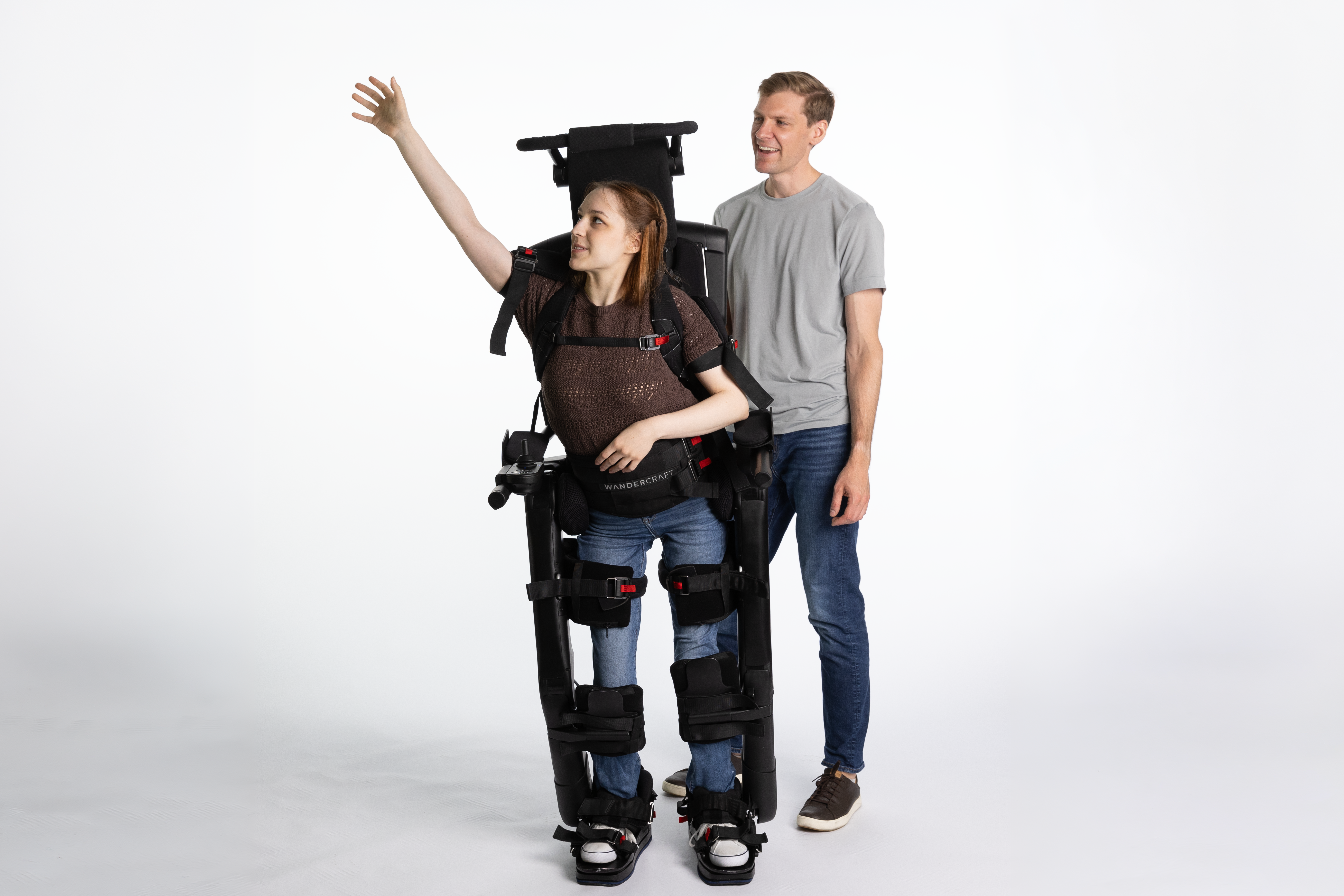
East Hanover, NJ, August 11, 2026 – The U.S. Food and Drug Administration has cleared Eve™, the first self-balancing personal exoskeleton for eligible wheelchair users living with spinal cord injury. Kessler Foundation was among the three U.S. research sites that participated in the clinical study supporting the clearance.
The FDA clearance marks a significant milestone in the advancement of mobility technologies that have the potential to expand independence and participation in daily life for people living with spinal cord injury.
FDA clearance was supported by a three-site clinical trial involving participants with spinal cord injury and their companions at Kessler Foundation, the James J. Peters Department of Veterans Affairs Medical Center, Bronx, NY, and the Walk in New York by Wandercraft walk center, New York, NY.
Eve enables eligible adults with spinal cord injury who can operate the device's remote control to walk and perform certain activities of daily living hands-free using self-balancing technology. The device is intended for use on level indoor surfaces and adjacent outdoor areas under the supervision of a specially trained companion.
The clinical trial focused on safety, function, training, and readiness for personal use. Participants represented a range of injury severities and completed structured training before undergoing functional, usability, and task-based assessments designed to reflect intended use in everyday environments.
The clinical program demonstrated that participants and companions could learn to operate Eve and complete activities relevant to personal use. Participants also met key functional and usability endpoints, including measures of walking performance and activities of daily living.
“What makes these findings meaningful is that the technology was evaluated not only on engineering performance but also on how users and companions could safely integrate it into real-world activities,” said Gail Forrest, PhD, director of the Tim and Caroline Reynolds Center for Spinal Stimulation at Kessler Foundation. “The combination of functional performance, usability, and user-reported outcomes gives this technology substantial clinical relevance.”
“At Kessler Foundation, our mission is to advance research that leads to real-world solutions for people with disabilities,” said Rodger DeRose, president and chief executive officer of Kessler Foundation. “The FDA clearance of Eve represents the kind of innovation that can help translate years of scientific discovery into meaningful opportunities for greater independence, mobility, and participation in everyday life. We are proud that Kessler Foundation's researchers and study participants contributed to this important milestone.”
According to the National Spinal Cord Injury Statistical Center, an estimated 308,620 people in the U.S. are living with traumatic spinal cord injury, with approximately 18,400 new cases occurring each year. For many individuals, the ability to stand and move upright can affect physical health, social engagement, and participation in everyday activities.
Participants in the study reported improvements in several aspects of daily life, including health status, psychological well-being, endurance during daily activities, lower-limb spasticity, and sitting balance. Some participants also reported improvements in sleep quality and bladder and bowel function.
Wandercraft plans to commercially launch Eve in the United States on Sept. 17, 2026.
About Kessler Foundation
Kessler Foundation, founded in 1985, is a New Jersey-based nonprofit and global leader in rehabilitation research committed to changing the lives of people with disabilities. By conducting groundbreaking research, Kessler Foundation advances recovery and fosters independence to build a more inclusive and accessible world.
Our team of award-winning scientists develop and test novel interventions to transform care and optimize mobility, cognition, and quality of life for people with traumatic brain injury, spinal cord injury, stroke, multiple sclerosis, autism, and other neurological and developmental disabilities. By analyzing community and workforce participation, developing evidence-based solutions, and funding impactful community initiatives that expand employment opportunities, Kessler Foundation also addresses barriers to inclusion for people with disabilities.
Powered by a dedicated team of over 175 professionals funded by federal and state grants and private philanthropy, Kessler Foundation is redefining what is possible in rehabilitation care and recovery. For more information, visit kesslerfoundation.org.
